Wow, has it really been 10 years of Apple Music? In some ways, it feels like Apple Music has been here for longer than that. I was a Beats Music user before it became Apple Music. A decade is still a decade.
To celebrate, Apple has released a 10 Years of Apple Music: Top Songs playlist. It features the 500 most-streamed songs of the last decade of Apple Music. Some great songs in there, to be sure.
I've been keeping this playlist on shuffle and repeat.
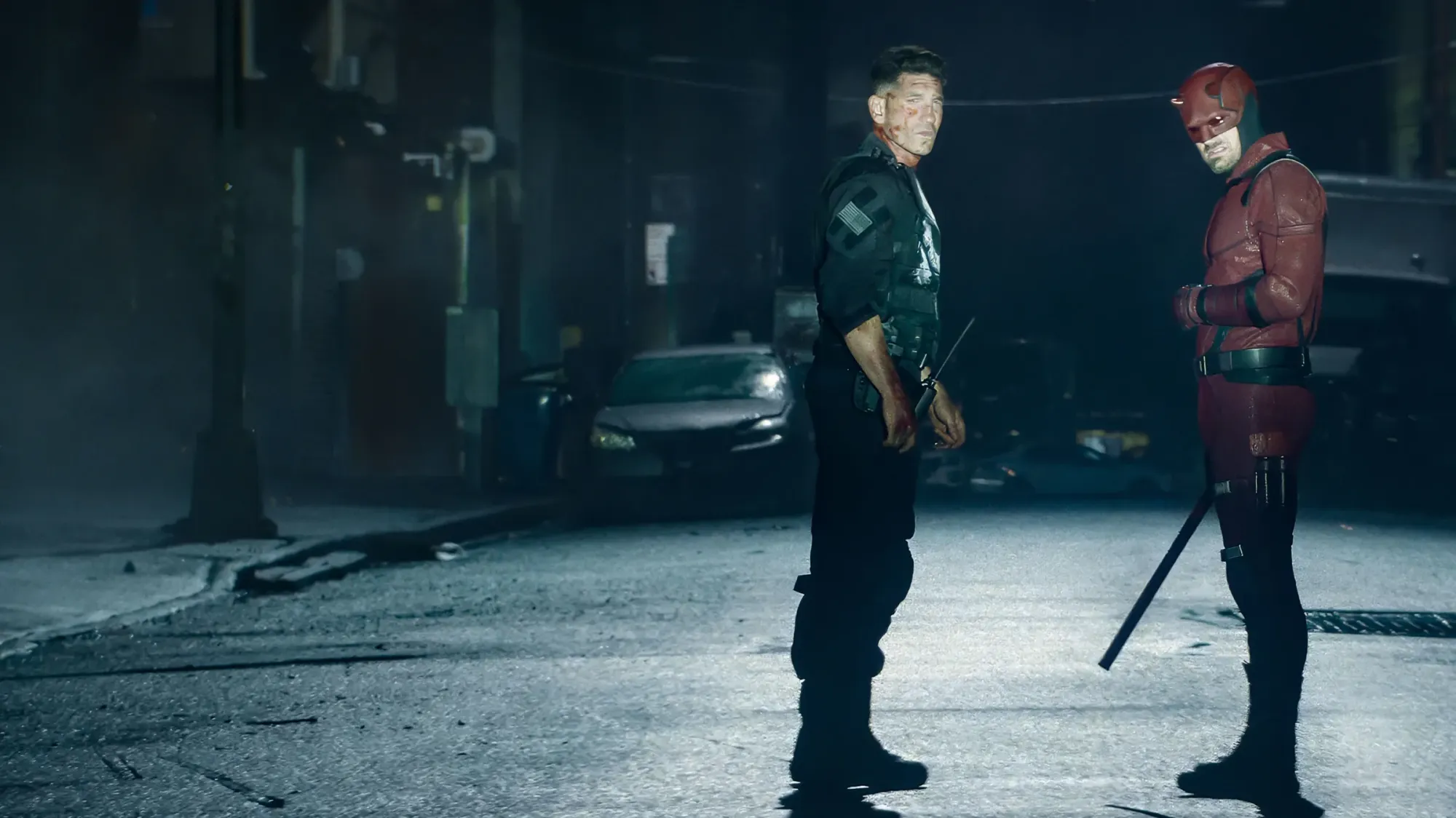
I've been behind on streaming superhero shows. It has taken me a bit to catch up. I had yesterday off, and now today, for the 4th of July holiday. The nice thing has been catching up on series I've been behind on. One of those is Daredevil: Born Again.
No spoilers – here are my thoughts on the series.
First off, I liked it, but I didn't love it. There are elements that left me scratching my head, but overall, I had a good time with the series. I'm excited to see where season 2 goes. If I have any "meh" about this series, it's just that it seemed to be setting up for a season 2 more than standing on its own, which is a weird thing to write, given how enthralled I was as I binged the series.
The first episode hits with a bang, and then the show settles into what feels like a completely different direction. This shift in tone – I don't know if that's accurate, but it's clearly a shift of some sort – left me unsettled for a couple episodes. Once the series hits it's stride, I was all in.
There's a lot to watch here. That may also be part of the series's problem. Lots of characters, lots of subplots. But wait, are these subplots or the actual plots? Who's the villain here? This, of course, becomes clear as the show reaches it's conclusion, but I wasn't sure along the way. Again, this is partly a strength of the series and partly it's weakness.
Characters and more characters in this Daredevil reboot
Fans of the original Netflix-based series will find lots to like here. The street level fights are the same intense, gritty action realism that we all loved from the originals. There are some added elements like Daredevil swinging around the city that just don't work quite as well. Those elements, while a nice touch for us comics nerds, feel too comic-booky compared to the grittiness of the original series.
There are also a couple cameos that I'm not sure if I loved or not. As one of these characters came on screen, I literally gasped and thought, "Wait, is that [...]?!" And then, I was like, "Oh hmmmm, why are they in this show?!"
If you haven't caught on yet, I've got mixed emotions everywhere with this show. I'm glad Daredevil is back. I'm also glad Disney seems committed to this series. Charlie Cox in particular is perfect as always. What great casting!
To wrap up, I'll say this – the series really gets to an interesting place by the last episode. I'm legit excited for season 2. As I mentioned above, this is also a problem with the series. The show doesn't have a satisfying resolution. Great comics find a way to tell a complete story and leave you wanting more. With Daredevil: Born Again, I was mostly just left wanting more.
I found Mitchell Hashimoto's My Approach to Building Large Technical Projects via Simon Willison's link post. Man, everything in this post is golden. I think I agree with every word. This is definitely how I approach building software. I especially love the focus on getting to something workable as soon as possible.
Building a demo also provides you with invaluable product feedback. You can quickly intuit whether something feels good, even if it isn't fully functional. These aren't "minimum viable products", because they really aren't viable, but they're good enough to provide an engineer some valuable self-reflection.
I love that phrase "self-reflection." We need more of that in software these days.
I also love the idea of building software for yourself. I've got some things I've been meaning to work on that I need to get back to. As I do, I'm going to get to a workable demo as quickly as I can. Maybe I'll have something to show here soon.
And so, the new year is upon us. Wow, what a year has it been. This past year saw my family settling into our second year in Atlanta. My younger daughter started her senior year of high school. It's hard to believe, but my wife and I are almost empty nesters. My older daughter finished school at Aveda Institute and started working full time. I changed jobs myself and then went back to grad school. Then, I had to withdraw. I also managed a fair amount of writing, publishing the first part of my comic series Hartwell and managing a short story or two.
Again, wow. What a year!
In looking ahead for this coming year, I expect more change. My youngest will go off to college somewhere this fall. We'll likely take an extended trip this summer to celebrate her graduation. We'll see where 2025 leads soon enough!
With all the change that happened last year, this site languished a bit. I did write more on here than other recent sites I've maintained. I want to do more in 2025. More writing. More software. I'm also going to be making some site updates to freshen up the look and functionality here, too. More details on all this as it develops.
Here's hoping your new year is exciting and filled with wonder and good things. Cheers!
Best laid plans and all. The intent was to go to grad school at SCAD here in Atlanta. I was thinking I would write, grow myself as a writer, and with MFA in hand, go teach when I'm done working as a software developer. Ha! Joke's on me.
I made it to midterms at SCAD and then life intervened. Or rather, everything that could go wrong did. There was a change in CTO where I work. Lots of meetings ensued as we all scrambled to figure out what this meant for our teams. I had to work a couple late nights. Not a lot of after hours work, mind you, but SCAD has a strict attendance policy. Those couple of after-hours nights combined with a week I needed to miss due to an on-site event for my team, and in the end, I had to withdraw. My time at SCAD, for this quarter at least, is done.
There are options that would enable me to keep at it. I could take online classes, but much of the appeal for me, beyond the degree and where it could lead, was the in-person classes. I work online all day for my day job. The thought of doing that in the evenings for school seems not fun. I could try again and take a lighter load. That's an option, too. I've got some figuring things out to do.
It's been a little quiet here lately on my site. I want to say "I've been busy," but that's the lazy too-common excuse. I've been focused. There, that's it.
I just finished up with a nice 5 day vacation for Dragon Con. It really is a magical time of year for me. I started going 7 or 8 years ago with my oldest daughter, and now it's a family thing. My wife and younger daughter join in with us now. It's a great time. The girls are older now – 21 and nearly 18 – so they do their own thing. My wife and I do our thing. We meet up occasionally in a panel. It's a blast.
I took a break from writing anything serious during Dragon Con, either creatively or here on my site. It's my one time of year to check out from everything – professional work, creative work – and just take it all in. Be present. It's a fun convention but also a great reminder that I'm not just the things I do. It's my yearly reset.
I'm back at some creative writing now, and I have a draft of a thing I'd like to get done before I start grad school on Monday. Best laid plans and all that, I'm not sure I'll make it. I'm putting in the work, though. I'll have more to say about that when it's ready.
I'm also trying out the socials more again. Threads and Instagram are my mainstays, but I'm trying a bit of Blue Sky too. Come say hello there if you like. I have thoughts and feelings about these sites, but I do like to connect with other like-minded folks. I'm making a run at it again to see if that's still possible with these type of sites. I hate the term "social media" but it is the social element that draws me back. I'll let you know how it goes.
Just wanted to post an update here so you all know I'm still alive and well and writing. Until next time.
Part of what I'm interested in exploring as I go to grad school at SCAD is writing on the web. Not just writing on the web – though I am interested in how creative writing on the web can itself be an object of art – but also, I'm interested in writing on the web as compared to traditional publishing. I've been thinking about this a lot lately.
I’m not sure if publishing is a good word here, but what I mean is writing in books, magazines, news papers, or generally anything of a print nature. Despite the very digital world we live in, traditional print media remains and is going strong. I think this is great, but obviously, writing on the web, in ebooks, and in other forms of digital media proliferates. There's literally writing every where we look. Why hasn't reading on the web or in ebook format overtaken physical books at this point in our culture?
I first started thinking about this several years ago when my kids were younger. They've grown up on the Internet, and yet, they still prefer reading physical books to ebooks. It's not as strange to me now that I'm used to it. Also, it's a well understood thing – ebooks are a nice compliment to the traditional publishing business. Readers and non-readers alike prefer physical books. I mean, if I'm being honest, I like physical books better myself, which also seems like it should be out of character for me. I've built my life and career on the web. I'm a gadget guy too. I've had just about every iPad or Kindle there has been. Still, I prefer a book in hand to an ebook.
Why is this?
Beyond the obvious benefits that come to mind with physical books – they're cheaper, safer to carry with you, easier to flip between pages, etc. – there is something "real" about them compared to ebooks. There's an actual weight to the object in your hand or in your backpack. Even before you've read a word, you know what you're in for when holding a book in your hand. The same can't be said of a book on your phone or an e-reader. Writing on the web just doesn't have the same weight.
This makes sense from a software point of view too. Digital work is inherently ephemeral. Web sites are here today, gone tomorrow. Digital bits are easy to copy, which scared writers initially, but digital bits are also easy to delete. When something can be so easily created and then deleted, what does that mean for the content itself?
There's a follow-on to this that is obvious now that we've been living in the internet age for a few decades. The web and digital content leads to an inherent lack of authority. The web doesn't have the physical weight or the the authorial weight in quite the same way physical books do.
I can think of a few counter examples of web content that has managed to rise above and throw its weight around.
The New York Times has done a great job of reinventing itself for the web. In the comics world, Lore Olympus has all but defined the webtoons genre of comics but has also gone on to sell books in traditional book stores. If you want an example of a book that's better online than in print, check out the book Making Something Wonderful: Steve Jobs in his own words from the Steve Jobs Archive. The Internet Archive has also done a great job of preserving all that has happened on the web.
There are some patterns emerging here – a care for the craft, a focus on the work as an object of art. Preservation, making something that lasts. Putting the work in as many hands across as many formats as possible. That seems like the way forward for us.
Maybe this approach isn't all that different from what artists have done at other times in our history. Make art. That's it. The way to lend more weight to writing on the web is to focus on making great art, making something meaningful and lasting, even as everything else on the web comes and goes.
I'm excited to share that I will be starting graduate school at SCAD this fall. I will be attending SCAD in Atlanta and pursuing an M.F.A. in Writing. I am very excited to be going back to grad school!
I say "going back" because I did do a semester of grad school at Auburn, after I completed my undergraduate degree in English. SCAD will be an all new experience for me, both as an art school and because it's been a few years since I was in school. I'm looking forward to the journey ahead of me.
I mentioned in my Just typing away post that I was applying to grad school and that this site would be about that journey. Now that I've been accepted, that becomes all the more true. Many of the things I'm exploring here – creative writing, the web, digital formats, generative AI, and comics – will be themes of my graduate work at SCAD. Stay tuned!
“Anderycks” is an online username or handle that I’ve been using for a few years now. It’s my social media username and my gamer tag. You can find me as @Anderycks on just about any platform. It seemed a natural thing to use the same name as my website’s name.
The word itself is an amalgam of my real name “Deryck” and my long time Second Life username, “Anders Falworth.” I put “Anders” and “Deryck” together and came up with “Anderycks.” It represents the blending of real life and digital life, or what’s possible when humanity meets the digital. I pronounce it like And-er-icks, but it’s a made up word. Say it however you like!
As I mentioned in the intro post about my comic and the family writing contest, I spent a lot of time last year using generative AI tools to help me create a comic book. That comic is Hartwell. Please check it out. Without the help of generative AI tools, I almost certainly couldn’t have created the comic. I think it stands as a good example of what can be done with the help of AI technology.
Before we get into the specifics of what I did, let me just acknowledge that I don’t think my comic is a spectacular piece of art. It’s very amateur looking, I know. The main character isn’t consistently drawn. There are proportion and perspective issues. The lettering isn't consistent throughout. But – I think! – you can follow the story. That really was my goal here – to be able to create something as an example of the kind of comic I wanted to create.
This also speaks to what works well, and what doesn't work so well, when using generative AI tools. But more on that in the next post! This post is about how I created the sample comic pages.
Now that this 3-page prototype is done, I hope to use it as a demo to help me find a proper comic artist to partner with to help me with the web series. That's why it's just 3 pages. It's a demo or a prototype. If you're an artist interested in working with me on the series, let's get in touch!
That's what's behind the comic. So how did I do it?
Write a script and generate reference images
I built out the idea for this comic series as a writer would – by writing! I wrote a series pitch, character breakdowns, and a full series plot outline. I wrote a full script for the first issue based on that series outline. I didn't have a specific artist in mind when I wrote that first script, but I did write it as if I was going to work with an artist on the comic.
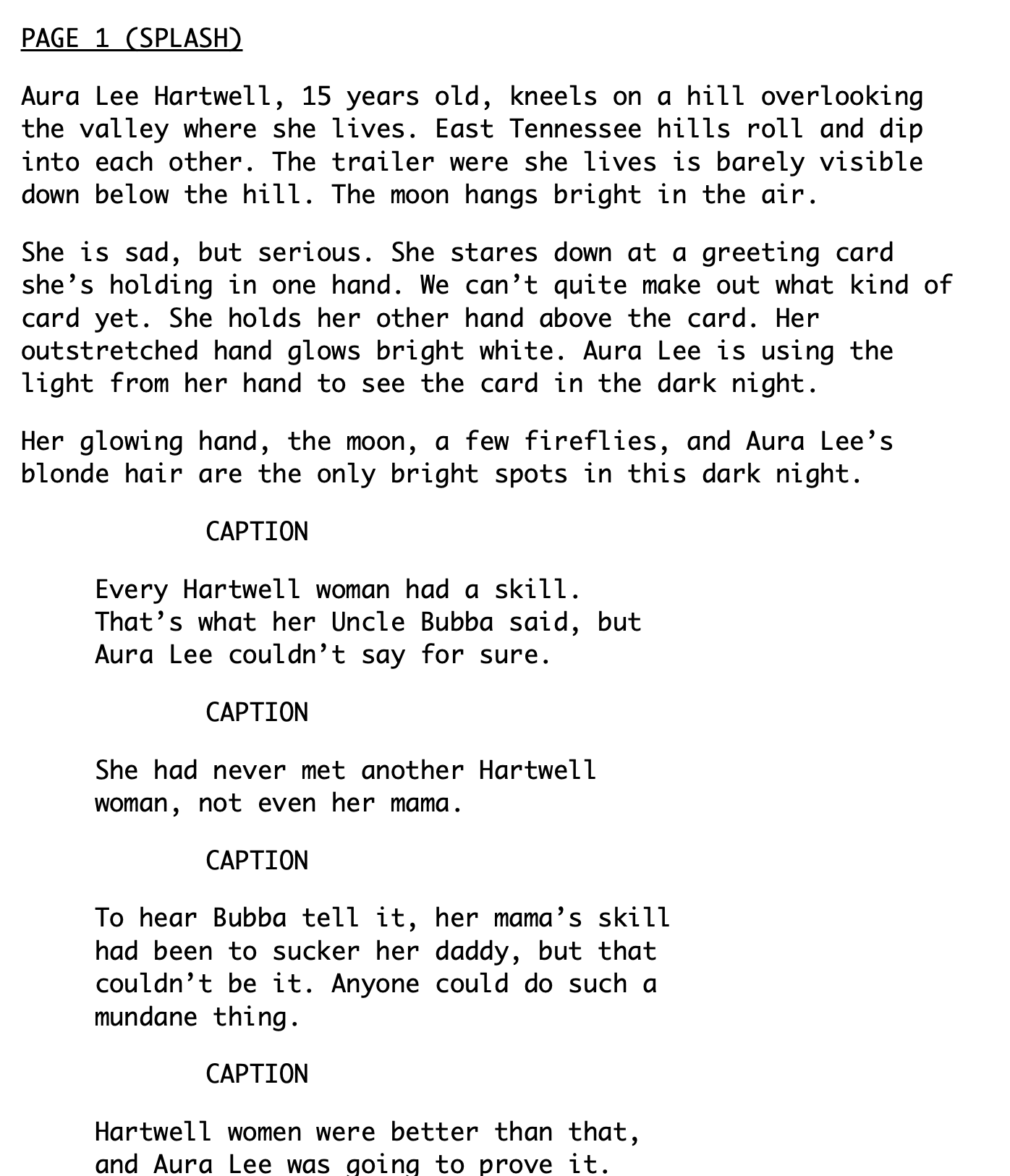
The opening splash page from the script
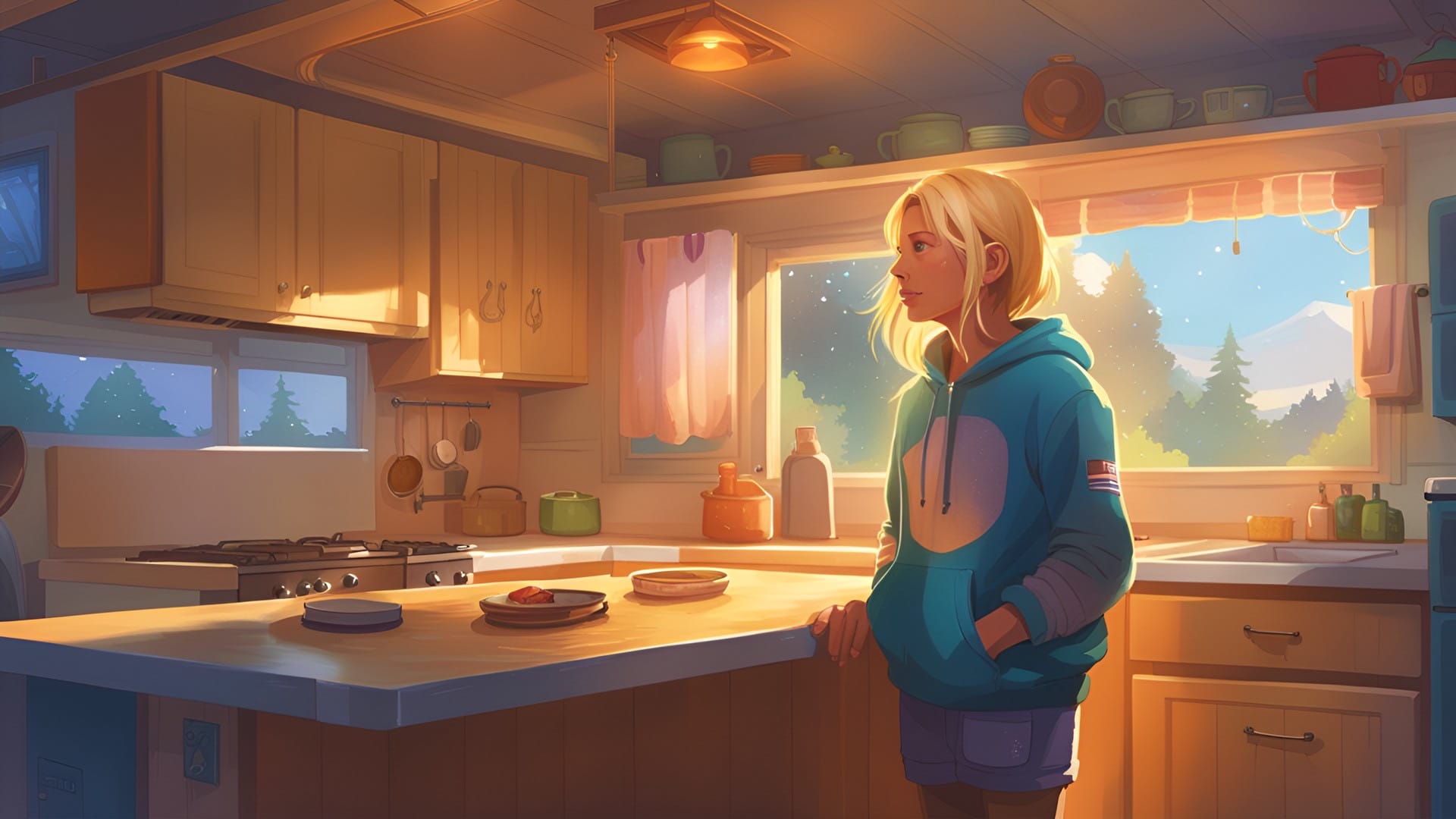
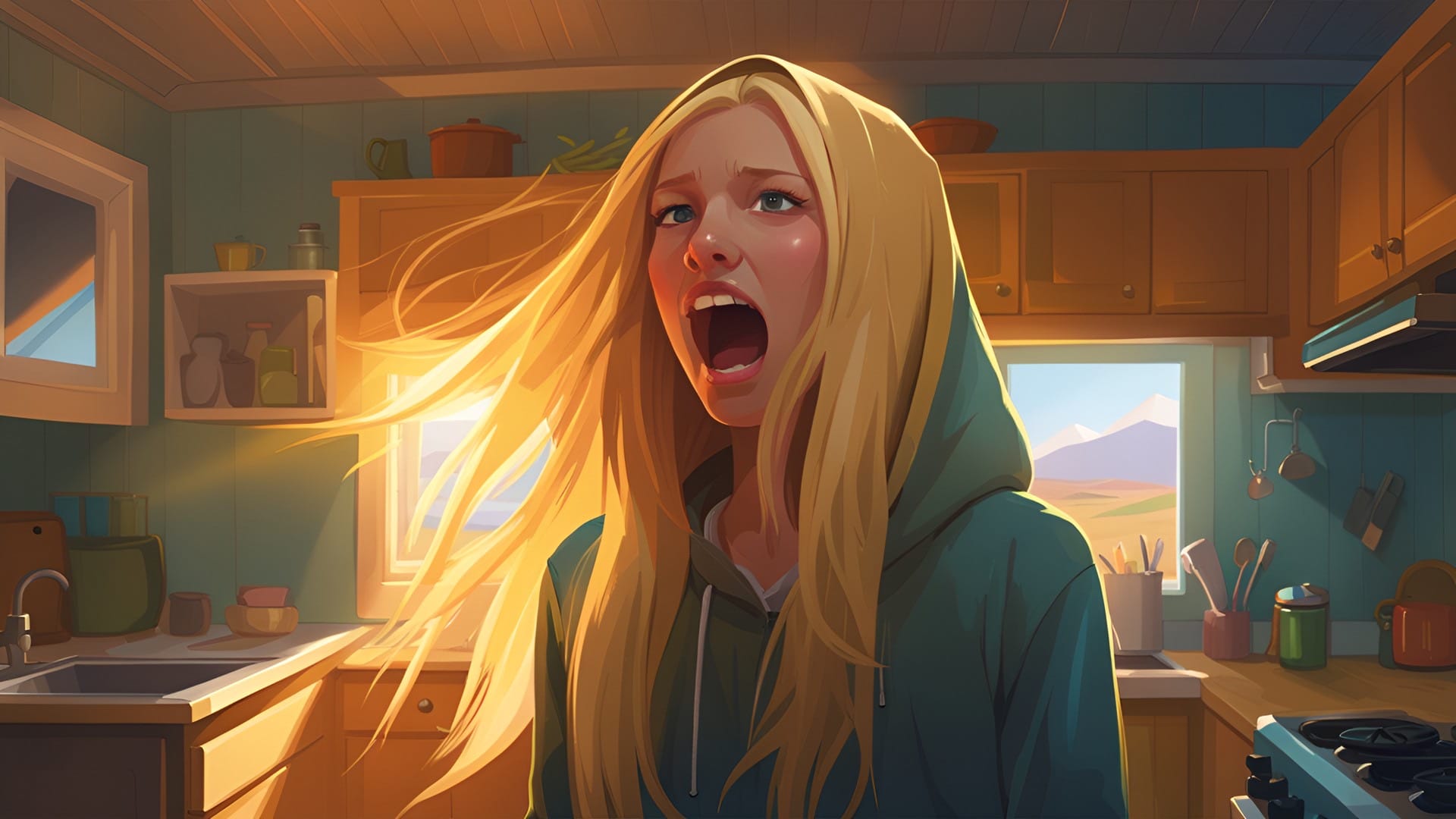
With the script done, I wanted to generate reference images for the first few pages. I really just pasted directly from the script into a few different generative AI tools. I tried them all, I think. I settled on Dream by WOMBO because the style was easiest to work from as reference images, at least for me. I also found Dream easy to use as an iPad app, since I was also using Procreate on my iPad for creating the comic.
A sample of reference images generated with Dream by WOMBO
To get usable reference images, I usually had to massage the text I pasted from the script. Generative AI tools can't keep track of a character like a human artist can, so "Aura Lee Hartwell" had to be replaced frequently with "a 15 year old blonde girl." This is also one of the limitations of these kinds of tools. It's all prompt hacking to get something you can work with.
I had a couple different techniques for getting images in a format that would work well with the page layout I wanted. Sometimes, I generated the images in the aspect ratio I wanted; sometimes I cropped them after they were generated. I did this because it's not always easy to get a usable image out of these generative AI tools. With images in the size and shape I wanted, I laid out the comic page, created page borders around them, and then dialed down the opacity of the reference images to allow me to sketch over top of the images.
Adding pencils, inks, colors, and lettering
From there, I tried my best to emulate how a comic art team would work. I started with pencils. Once I had the pencils, I hid the generative AI reference images layer. Then, I inked the page and added colors and the lettering. It was during this phase that I tried my best to pull each page together into a cohesive comic, trying to have a consistent character design and style to each page.
It's kind of hard to understand what I mean by this without seeing it in action. Procreate allows me to share the process I used, which is really nice. Here's a timelapse video of my work on one of the pages.
It's probably worth mentioning here that I do have some very basic art skills. I'm not a great artist, but I can draw a straight line. I've had a few art classes. I have loved comics and have doodled my whole life, but again, I'm not really a great artist. However, those art skills, insufficient as they were, did make it possible to pull all this together. I think that's the trick with generative AI. It helps someone with basic skill do something they couldn't otherwise do. It's never going to replace what a real artist can do, and it's not really able to help someone who can't imagine how to put the tool to use.
That's the story of how I came to create the prototype pages for Hartwell. I can't wait to share how this comic grows and develops once I start working with a real artist on it.
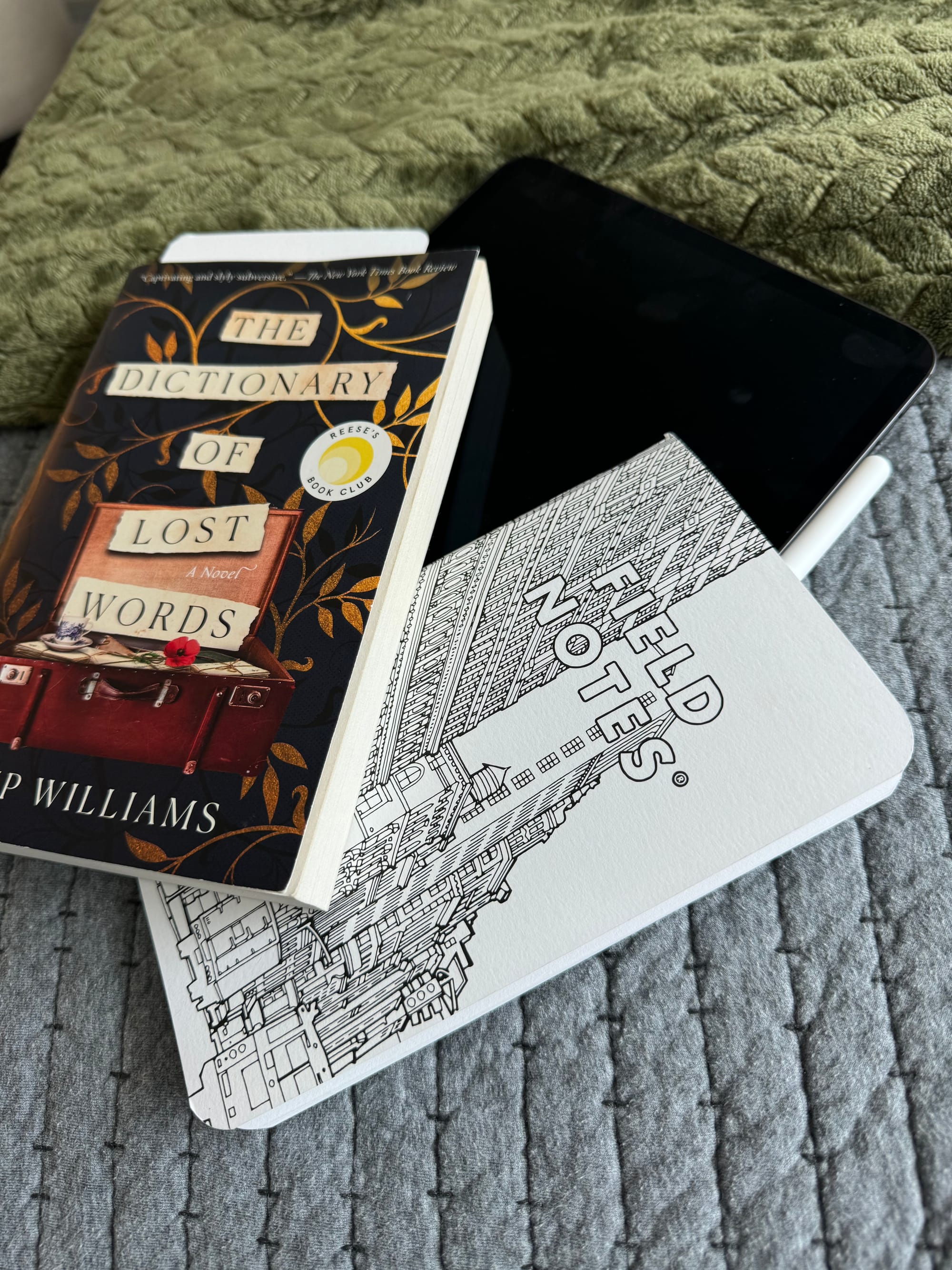
This afternoon, I'm leaving for a Fourth of July beach trip. I'm sitting here going round and round about whether or not I take my iPad. It's a silly debate I'm having with myself. "Just take the iPad if you want to take the iPad, Deryck," I hear you say – believe me, I'm telling myself the same thing – but I've been in this to-paper or not-to-paper mood lately. That is the question at hand.
I tend to use my iPad for things that have nice paper compliments. It's a notebook, a journal, and a sketchbook all in one device. I also use it for reading books, comics, and magazines. It really does shine for this, especially for comics. Earlier this year, I started to put it down more in favor of physical books and notebooks. I've always flipped between paper and iPad, but when I left Apple, I wanted to lean in more on my writing and creative life. Paper is a more visceral connection to the creative experience for me. The iPad is just a tool.
Several years ago, Cory Doctorow wrote about how giving away ebooks had been good for helping him build an audience for his print books. He spoke about readers being people who are "positively pervy for paper." That phrase stuck with me. He meant it in a a good way, as a sign that the print business isn't going anywhere, even as ebooks flourish. I've always worried about the negative connotations of that phrase for myself. I don't want to be stuck in paper because of some emotional attachment. There are upsides to digital too – carrying more books with you, new forms of story telling, and so much more.
Yes, packing my bag has turned into an existential crisis where paper and digital must battle to the death. Welcome to my brain.
A book, a notebook, and an iPad battle it out for space in my travel bag
Every year, my family has a family writing contest. The first year, it was a thing my older daughter and I did on a whim. There’s this church out in the boonies where we have a family Christmas get together. It’s a long drive out there, so we passed the time making up stories using the phrase “the church at the end of the road.” From there, a plan was made — we would each take the remaining two weeks before Christmas and write our own short story based on this prompt. The rest of our family – my wife, the aunts and uncles – would pick the winner. This is how the family writing contest was born.
My daughter won that round, but I ended up with a short story appropriately called "The Church at the End of the Road." I’m happy with the story, even if I lost the contest.
We held the family writing contest again last year. This time my younger daughter joined in. She had been developing her craft as an actor and screenwriter. We decided this year would be longer works, so the three of us devoted the entire year to a long work. My older daughter worked on a fantasy epic novel, my younger daughter a screenplay. I decided to pursue a life-long dream to create a comic book series. Neither my older daughter nor I fully completed our works. We were too ambitious. My younger daughter’s screenplay was not only complete, but also, a really good story. She won the second round, but like the first round, I was left with something I’m really proud of.
Go check out my site for Hartwell. Hartwell is a Southern Gothic family drama for all ages set in a realistic setting where extraordinary powers and spectacular events are everyday occurrences. I was able to create this comic because I used generative AI tools to help me. In my next post, I’ll explain what that process was like and what I think works well, and what doesn’t work so well, with generative AI tools.
Oh, and the family writing contest continues this year! We’re working on our pieces through out the year, just like last year, and this time, my sister and brother are joining in. More on this year’s contest at some point later in the year.
I get something like this question all the time. Should I get a computer science degree? Should I do a development boot camp? The general point of the question being, what is the best way to get started working in software development?
Since I'm asked this so often, I thought I would put my answer here on my blog. Also, the answer is relevant for several things I'm doing lately and for where software development is heading these days.
First...
Decide if you want to go to college
If a degree isn't important to you and you want to just start working, go to a bootcamp. All that matters when looking for a programming job is knowing how to code. A bootcamp is a great way into the industry.
If you do want a college degree or if getting an education is important to you – and I can't stress enough that I'm a big believer in higher education – then take the following path.
Start by getting a liberal arts degree
I can't stress this enough given that state of the technology industry. AI is impacting everything. It's probably going to affect coding itself. Routine, work-a-day coding is going to be done with less developers. You know what isn't going to change? Having carefully crafted thoughts about what all this means and how best to write software for human beings.
The best way to understand what it means to be human is not with a computer science degree. It's with a liberal arts degree.
Major in English. History. Political Science. Philosophy. Anything other than computer science.
While you're in college, working on that liberal arts degree...
Take a couple programming classes
I would focus on the intro to coding style classes. Learn the basics of programming. Then take anything your university offers related to app or web development. Probably 2-3 classes is enough. That's less than a minor.
Then...
Go build something
Programming is something you learn by practice. Build web sites. Build apps. Build a web site for your sports or gaming league. Build your own blog. Write an app for your favorite hobby. Whatever interrests you, find a way to build some software for it.
You get better at coding by doing it. Write software. But make it fun.
When all that is done...
Go get a job
Highlight the things you've built on your resume in a portfolio section. Be clear that you have a liberal arts degree because you wanted to study what it means to be human, but now, you're really looking for a programming job.
Then, profit. Or save your money well. Or go back to grad school part time for advanced study in computer science or the liberal arts. At this point, you've done it. You've made it as a programmer. Now it's up to you what you do with it, but hopefully, you understand that well because you're a programmer with a liberal arts degree.
It's not like this idea hasn't always been simmering, just there under the surface of the day to day work I do. Anyone who knows me well will not be surprised that I want to return to grad school. Writing and teaching are passions that have never really left, even as my career as a software engineer and manager has taken off. I lacked the nudge I needed to see it through to actually commit myself to the idea and apply.
Before the reset started, I asked myself, "what will I do with myself every day?" So I didn't plan. I got up each day and did what I wanted. As I wrote in the post I linked above, that turned out to be a lot of video games, reading, and writing. And I realized – if left to myself, I always default to books and writing. It was some much needed perspective.
Getting a job at Apple was the highest of highs in my career. Leaving that job at Apple so quickly was the lowest of lows. With my reset period and the perspective it brought, I realized career success is not really something I care that much about. I enjoy writing software. I find satisfaction in my work as a manager, but it's spending time with books, ideas, and creative work that really matters to me. I had lost a bit of that in all the career rat race that last few years.
So I decided: it's time to get back to grad school. If it all comes together, I'm excited about the focused work, the creative environment, and the things that will grow from that. I don't have any plans beyond that, and I couldn't be happier for that new perspective.
For the next few weeks, I'll be spending all my extracurricular effort on finishing my application to grad school. If I get accepted – no, when I get accepted (manifesting it, right?!) – I'll pursue an MFA in Writing at SCAD here in Atlanta. This is all life-comes-full-circle for me. I didn't start out professionally as a web developer. Twenty-two years ago, I graduated with a degree in English. My entire focus at that time was on teaching and writing. It seems like both a lifetime ago and like nothing has changed at all.
I'm sure for some who know me, they probably never realized I was anything other than a writer. "What's Deryck up to these days?" I imagine one friend asking. The other says, "Spending all day at a computer, just typing away."
That's it, really. Just typing away. That's the through line. There are other similarities too.
Writing is about structure and point of view. So is software. In both prose and in software, the audience is an ever present fixture in the mind of the writer or developer. Both acts are driven by long periods of solitude followed by brief moments of eureka and euphoria. Then, back again to the solitude and the work. It's often more challenging than rewarding, and yet, there's something that seems empty about life for a writer or developer who goes too long without that act of just typing away.
It's this link that I find compelling and that I want to explore in my graduate work. I want to play with form in fiction and in its presentation online, and I want to create beautiful stories that are somehow both great pieces of writing and great pieces of software. This blog will be about that journey.
I recently quit my job at Apple. More on that in a later post, but for now, the main point is that I've spent the last 3 weeks unemployed. I can't recommend 3 weeks of uninterrupted time off enough, even if you have to quit your job to get it. It's glorious.
I played video games. I caught up on film and TV. I read books and comics. I even made a pilgrimage to every comic shop within 15 miles of my apartment. But more than all that, I rested. Truly rested.
I regularly take vacations throughout the year. I'm a big fan of time off and rest in order to be able to recharge, but I've never taken an extended period off between jobs before. It's something else entirely. It wasn't just rest. It was a reset. I left the old job behind, did nothing except what I wanted to do for 3 weeks, and found myself again in the process.
I don't really know how to explain "found myself" here, except to say, I feel calmer, more at peace. I respect work. I appreciate my new job. I am able now to put it in its proper place. After this reset, I hope I don't allow myself to get back in that place where work is everything. It's important and needed, but there's so much more to life. I'm able to appreciate that more now than I did 3 weeks ago.
Consider this my "hello, world!" Though if I'm being honest, this is like the 3rd iteration of this website.
I love the name of the site, but I keep searching for what to write about. So I start something at anderycks.net and then end up not liking the direction I take the site. I tear it all down and start over.
Whenever I start up a new version of this site, I get the worst writer's block, and it usually results in me writing a silly "well, I'm back at blogging" post. Not this time! Instead, here it is – first post!
Now that that's out of the way, let's see what I can get into here. This site might grow slowly, but I'm going to focus on finding the fit for me and build it intentionally this time. Wish me luck!