I’m sure my recent writings here might lead some to think I’m critical of using generative AI. That’s not really accurate. I see generative AI as normal technology. It has its uses, and we should understand what the best of those are. I am, however, very much in the camp of being critical of the stories we tell ourselves about generative AI.
Stories leave a lasting impression. I’m much more worried about bad stories than bad uses of AI.
That’s why you’ll see a lot of writing here that is critical of AI hype. Or writing that is critical of stories that cause fear and panic about AI. I’m critical of the extremes, those stories at either end of the booster or doomer spectrum.
AI is just normal technology. It has some good uses, and it has some bad ones. We should figure out where that line is, intellectually and rationally, not in a fictional world defined by the companies who most benefit from these fictional tales.
In 2023, the FTC challenged patents it said were improperly listed, pushing drug manufacturers to allow generic, cheaper versions of some asthma inhalers. And Khan dusted off a 1973 rule originally inspired by book-of-the-month club enforcement and tried to use it to require sellers to make it easier for people to click to cancel online subscriptions.
She went after Amazon for fees charged to businesses selling on the platform. She also moved to stop a $24.6 billion acquisition of the Albertsons grocery chain by Kroger on the grounds that it would raise costs and reduce consumer choice. The acquisition was eventually abandoned after a federal judge blocked the deal.
Today, Khan says the “affordability part of the conversation” inside the Democratic Party must be “paired with accountability.”
It’s a great piece on Khan’s influence on folks across the political spectrum. I knew she was both influential and polarizing, but it seems now, Democrats are more interested in embracing her ideas than ever before. That’s a new shift, and I wouldn’t have been aware without this reporting.
I feel a little off today if I’m being honest. I want to write, but I don’t know if I have it in me to continue at this pace, this unrelenting pace. 1000 words a day is a lot of writing. It never lets up if you keep at it, and I want to keep at it. I must keep at it.
Writing, for me, is the thing that helps make sense of the world. The world, like those thousand words I’m trying to hit, is unrelenting. It never lets up with its rhythm or requirements, its expectations, its temptations, the need to be heard and seen and felt. The world wants to take. Writing wants to give.
It’s like that with technology, too. The pace. Everything is about pace in tech. They like the word productivity, but don’t be fooled, it’s unrelenting pace that they care about. Do more. Make more. Go faster. Win, before we lose, or run out of time, or die. Writing is how we really survive.
It’s counterintuitive, the way writing resists. Here I was just three paragraphs ago feeling the same pressure to perform, to deliver. But I sat down. I got still. I let the words appear, one after the other. A new rhythm develops, a softer more reflective one. It explains. It defines. It survives.
Puck has an article from inside the HumanX conference, what the article calls “the quintessential A.I. conference for operators.” In that piece, Silicon Valley’s Anthropic Anxiety (gift link), Ian Krietzberg writes:
Silicon Valley is famous for proclaiming that things will never be the same, as PagerDuty C.E.O. Jennifer Tejada reminded me. Likewise, she said, the industry narrative surrounding A.I. is often oversimplified. She has large enterprise customers, for instance, that are still in the midst of a long-awaited transition to digital—only “20 percent of the way through their cloud transformations.” And with A.I., she said, “there’s still a big question” around what the high-value use cases are. Meanwhile, widespread A.I. tool adoption requires enterprises to both understand the risks and be able to mitigate them. “These kinds of transformations take a long time,” she said. “They move as fast as society can move, as fast as humans can move.”
I was chatting about a similar idea with a colleague at work today. Technical people often make predictions based on technical requirements, not on business constraints or human inertia. The question really, as Krietzberg outlines well in his piece, is can Anthropic and OpenAI outlast that inertia?
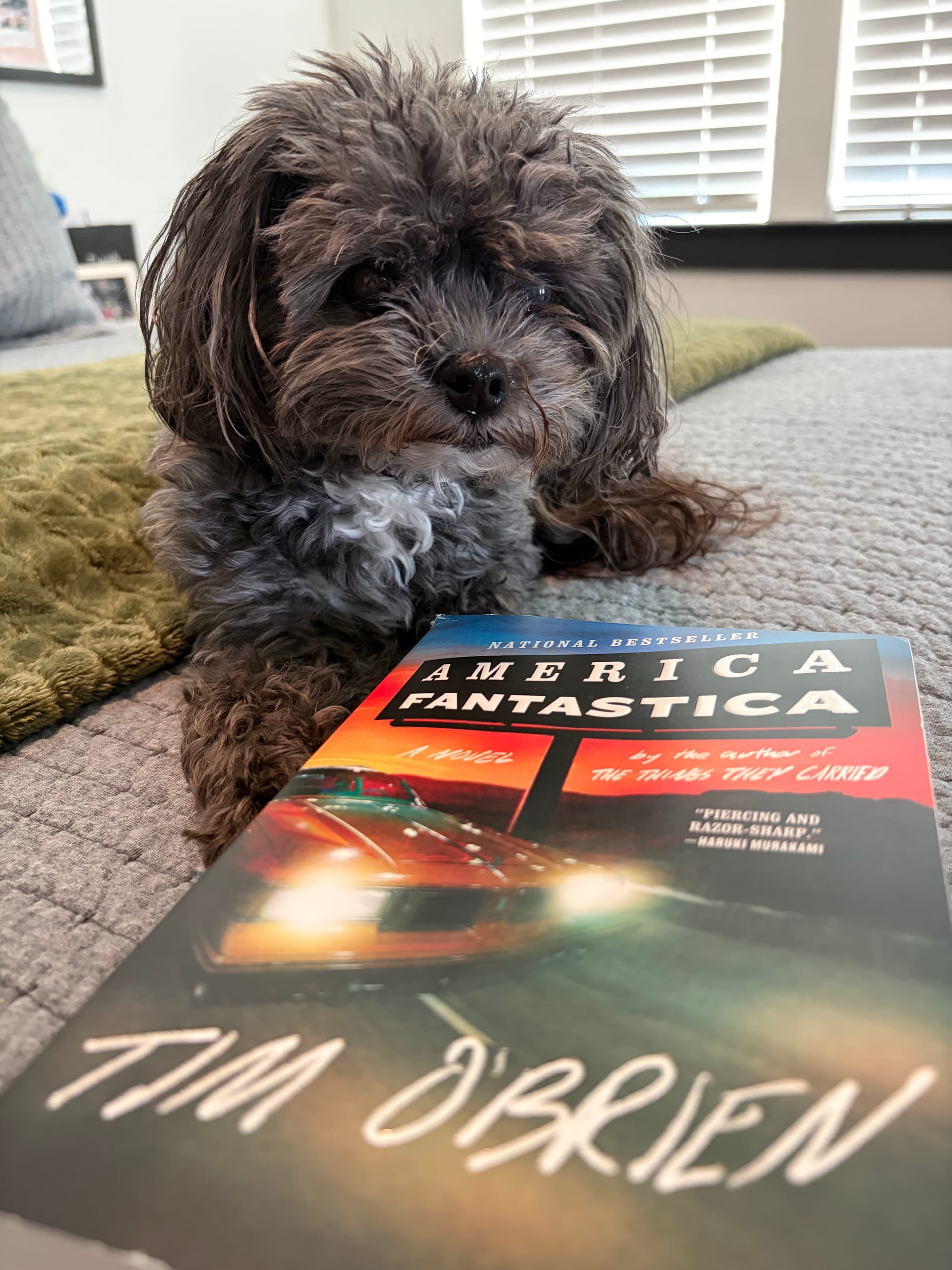
I just finished Tim O’Brien’s new book, America Fantastica. This book won’t be for everyone, but if you like literary fiction with a touch of crime and a road trip, this one is for you. Or if you’re a big Tim O’Brien fan. I’m all of those things, which means I really, really loved this book.
The back cover of the paperback has this blurb:
When Boyd Halverson—star journalist turned JPenney manager turned notorious online disinformation troll—robs a California bank and takes the teller, the intrepid Angie Bing, hostage, he has one goal before the authorities catch up with him: settle a score with the man who destroyed his life. Soon, the pair are being trailed by hitmen, jealous lovers, ex-cons, an heiress, a billionaire shipping tycoon, a three-tour veteran of Iraq, and the ghosts of Boyd's past. In the tradition of Jonathan Swift and Mark Twain, Tim O'Brien's America Fantastica brilliantly satirizes a nation and a time that has become dangerously unmoored from truth and greedy for outlandish fantasy.
That blurb and the cover copy in general really focus on misinformation, recent events like COVID, and our current polarized political climate. I wasn’t sure if I would like that. I tend to like more subtle fiction. In my experience, when a writer tries too hard to make a point, they often forget to bring the story with them.
That’s not the case here—the story is quite the ride.
Ruby couldn't put it down either
When I discovered O’Brien in college, I was drawn to the way his books were as much about story itself as they were whatever tale he was telling. This is the distinction between story truth and happening truth, an idea central to The Things They Carried. Those same ideas are at play here in America Fantastica but written in fresh form and in contemporary circumstances. That’s where all the lies, misinformation, and mythos aspects of this story sit within America Fantastica.
Those ideas might be featured here, but this is a fantastic story, too, with quick wit and clever writing from O’Brien. Tim O’Brien is one of my favorite authors. If I had to name a top two, it would be him and Flannery O’Connor. That’s how much I love his work. America Fantastica lives up to my expectations and anticipation. Highly recommend!
When I was 5 years old, my Granny and Granddaddy Hodge took me to Disney World. It’s one of the earliest memories I have. I remember sitting on the curb on Main Street, U.S.A, watching with wonder and pure happiness as the parade passed. I can remember how hot it was. I don’t think the air conditioning worked in my Granddaddy’s car. We stopped on the way back to Alabama to trade in that car. My grandparents loved to tell this story. Little 5 year old me said to my grandfather, in front of the salesman as if my grandfather had something to hide, “Don’t forget to tell him about the air, Granddaddy.” This was a magical trip for me and formative in how I think about entertainment and business.
I was living in Mississippi at that age, so it was a long trip for me. After we made it back to Alabama, I’m sure we rested up at my grandparents house before they would have had to make the trip back to Mississippi, in that new car, to return me to my mom. I was lonely in Mississippi even at 5 years old. I had no family there. My mom worked during the day and spent her evenings with random men I never really met. I spent my days in daycare and my nights with comic books and action figures, trying to image a better world for myself. Disney World with my grandparents was that better world, a place where I could be safe and sing along with everything enormous and magical going on around me.
A few years later, my mom and I moved back to Alabama. We were getting threatening calls at our apartment, which I understand now were probably from one of those men I never met. This terrified my mom, and when we got back to Alabama, she had her very own come to Jesus moment. It didn’t last that long for her, but the lasting effect for me was that I ended up in the ultra-conservative, independent Baptist, private Christian school run by my Grandmother Catchings’ church.
Normal Southern Baptists are hellfire and brimstone people. Independent Baptists are all that and more. Women couldn’t wear pants. Men and boys alike couldn’t wear shorts in PE class. I had to wear a tie to school. My hair had to be cut with what they called “white walls” above my ears and collar. I attended this school from 10 years old until I was 14. At some point in all that, I had to take a class called “Man in Demand.” It was taught by the preacher of that church. In class one day, the preacher told me that I would never be a real man because I was being raised at home by a single mom. Never mind that I saw my dad regularly throughout the year.
This preacher who told me this was the second preacher to run this church while I was there. When he joined, he was welcomed as a softer, more empathetic pastor for this congregation. That’s independent Baptists for you.
This kind of thing happened often at that church and school. I’m not sure what year it was but somewhere in there, there was talk of going back to Disney World. My cousins on the Catchings side lived in Orlando, and we were talking about a visit. I was hoping we could go to Disney World. I mentioned this in school, probably unable to contain my excitement about escaping that terrible place, and one of the teachers told me that the church didn’t support going to Disney World. Apparently, it was a place of filth designed to indoctrinate young children into the ways of Satan. I was like, “but have you been there?” Then I spent the afternoon in detention for smarting off to the teachers.
It’s a fair question, though, even if I didn’t know it then.
I’m sure none of the teachers working at that school could have afforded to go to Disney World. I wouldn’t have been able to either if not for my grandparents Hodge. They saved their money well while working at the local textile mill. They invested in the stock market. They started their own rental property business in that small Alabama city. It allowed them to travel. It allowed me to travel with them. It allowed my dad to get an education and get out of that city, which ultimately did the same for me.
It’s easy to be against something you’ve never experienced, and it’s easy to make commerce the villain if commerce isn’t working for you. That’s really what religious boycotts are all about. It’s about that lack of access and all the feelings that go along with that: frustration, resentment, anger, and fear. It’s the emotions that drive the boycott, not any sort of rational thinking. It’s all the same—whether Target or Tesla, DEI policies or Harry Potter, Disney World or Artificial Intelligence—where one person sees a religious war to wage, there’s a 5 year old in Mississippi, or a 10 year old in Alabama, who sees opportunity and the possibility of a better world.
I’m surprised by how many people in my circle aren’t aware of the great deal that is the Apple News+ subscription. Yeah, it’s $12.99 per month, which might seem like a lot for a news subscription, but it has literally 100s of subscriptions—both magazines and newspapers—that would all be hidden behind their own subscription fees. It’s actually a great value for what you get.
You can find 3 months free for new subscribers at Apple’s own News+ site. Lots of other places online offer bundled subscriptions too, especially with new device or new service purchases. Look around for deals. They’re out there.
I’m reading The New Yorker, Wired, The Atlantic, as well as The Wall Street Journal, The Washington Post, Los Angeles Times, and The Times of London. Those are all subscription based. I wouldn’t buy all of those individually, so Apple News+ is bringing me a lot of value.
Some clarifications and disclosures: I have no idea if this is a good deal for the news organizations themselves. I understand why a news site like The New York Times or CNN would want a direct to consumer relationship, rather than being mediated through Apple News. I work as a software developer for CNN but don't really work on or have insight into this part of our business.
All that aside, as a news and journalism fan, it’s an incredibly good deal. Check out Apple News+ if you haven’t already!
I wrote previously about the need to take a more skeptical view of Anthropic’s claims about Claude Mythos, its new model that is being released only in preview mode with select Anthropic partners. We’re now starting to get some information from those partners. Results are about what I would have expected. They’re certainly not anywhere near the level of world-ending AI that the “our model is too dangerous to release” approach implies.
Simon Willison—a software developer and blogger whose recent focus has been on generative-AI assisted coding—shared a couple links on this topic, which included a link to Our evaluation of Claude Mythos Preview’s cyber capabilities from the AI Security Institute. This is a research organization within the UK government's Department for Science, Innovation and Technology, so it’s an impartial evaluation I would trust.
The AISI describes their results:
Mythos Preview’s success on one cyber range indicates that is at least capable of autonomously attacking small, weakly defended and vulnerable enterprise systems where access to a network has been gained. However, our ranges have important differences from real-world environments that make them easier targets. They lack security features that are often present, such as active defenders and defensive tooling. There are also no penalties for the model for undertaking actions that would trigger security alerts. This means we cannot say for sure whether Mythos Preview would be able to attack well-defended systems.
They conclude:
Our testing shows that Mythos Preview can exploit systems with weak security posture, and it is likely that more models with these capabilities will be developed. This highlights the importance of cybersecurity basics, such as regular application of security updates, robust access controls, security configuration, and comprehensive logging.
Again, this feels normal to me, not software-world shattering. It seems Claude Mythos is indeed better at finding and using exploits, but these tests are being done in simulated environments. Criminal hackers could almost certainly use they to some success, but it doesn’t seem it would lead to anything approaching a shut-down-the-Internet level of security exploits.
I don’t mean to say we shouldn’t take these capabilities seriously. Of course, we should. This is impressive, technically speaking. Model capabilities are clearly improving, and software developers and technologists should understand the implications of those improvements. We should just be careful to not give Anthropic’s hyperbolic claims—claims meant to gin up fear, corporate interest, and spending on their services—any more weight than they deserve.
“I have two really big concerns,” she said. “One, that it’s being used to create fake information that’s destroying our whole information environment. And two, people are trusting them to do things that they shouldn’t be trusted to do. We overestimate their capabilities. There’s a lot of magical thinking about AI. But it must be said that if you let these systems loose in the real world and they have access to your bank account, even if they’re just role-playing, it could still have catastrophic effects.”
The emphasis above is mine. Calling content generated by an LLM “AI” was a marketing stroke of genius. The problem is people have bought into the fiction. That’s the power of a good story.
It might be near impossible to turn back from this perception and belief now, but we have to try. We need an even more powerful story. I appreciate that Gefter is trying.